Depends on the writer and the book as to the weirdness. Right now I am working on a manuscript. Very different from my other books and therefore the muse needs alternative stimulation. Currently listening to early Pink Floyd.

Depends on the writer and the book as to the weirdness. Right now I am working on a manuscript. Very different from my other books and therefore the muse needs alternative stimulation. Currently listening to early Pink Floyd.
I had a strange revelation this morning and maybe it is because I am not entirely awake, having not yet had my second cup of coffee. Yes, it is currently very dark o clock. I can’t sleep as usual. Anyhow, I was working on Facebook and it came to me how I pictured my friends on there.
Now this is the weird thing as most of you have profile pictures and some of you I have met in person, but I tend to think of your name in letters when I am reading your post or thinking of you on that site. Not the known image or memories, the written name. This is the identifying factor, much more than the profile picture, which may or may not have your image. I wonder if it is because most profile pictures tend to change, but a name does not?
Aside from that, I was idly playing with thoughts on what I would like to be on the cover of the second Otherworld series book, Serpent of the Shangrove. Now it absolutely has to have a dragon. That is a given. I think I would rather like the dragon/serpent to be in the Shangrove. Oh and I do have an image in my mind for that. It is on this trailer.
Someone asked me this the other day. Well the answer is both yes and no. Yes, I did base a Flash Fiction story on a very irritating real person and no, I would not put a real person into a book. It wouldn’t work as the personality would be already established, with all the little quirks, wants, wishes and needs. It would be like taking a bucket of water out of a rushing mountain stream and letting it sit there, trapped and stagnating. There is a lot of difference between a story of five hundred words and one of 100k+.
While my book characters are entirely fictitious, they then to spring to life fully formed, with strong personalities of their own in the world they inhabit. I couldn’t inflict artificial restraints on these free spirits in the form of an artificial personae of a real person grafted onto them. The first thing that comes to my mind is the resulting amalgams would be boring and predictable. Eeeew.
However, if a film ever got made of my Shadow books then I know which actor I would like to play Arthur. Don’t know his name, but he is perfect. 

The VBC is strangely disinclined to go out. I can’t imagine why?
This is something that flares up every so often. I can only assume the people who spy on others are so bored that anything is better than what they have in their lives. However, the notion that someone might be weird enough to watch me sit at my desktop is unnerving. Yes, I do have a webcam stuck to the top of my monitor with bluetac, a semi-sticky putty type adhesive a tad like gum. Over the lens of my webcam is not another lump of bluetac. It will come off easy enough when I want to use the device and in the meantime? Good luck looking through a sea of blue.
I read an interesting article extolling authors to break the established rules of writing. One of the suggestions was to pen something in third person omnipotent Right. There was a very, very good reason this style fell out of favor in the last century. Those who attempted it usually made a mess and ended up wildly head hopping and leaving the reader spinning. An example of how this should be done and usually wasn’t is Lord of the Rings by J.R.R.Tolkien. Now that was a shining example of excellence.
Another suggestion was to write a book about an antagonist. Really? How can a reader bond properly with a bad guy? Does anyone really want to be a cheer leader for Hannibal Lecter? Yes, the character was fascinating, but would anyone weep buckets if he happened to croak? Nope. This was a suggestion that was almost good and missed by a gnat’s whisker. An antagonist should have hopes, wants, wishes and needs. He/she should also have some redeeming features, whether it is a love of cats, or a kindness to those less fortunate. Without the redeeming features, he/she will not be as effective, or as real and scary. It also holds true that the protagonist should have a few flaws. Perfect Percy is boring. Give him some warts to liven him up.
I have in my hand a first editon signed copy of ‘Swish of the Curtain’ by Pamela Brown. The covers way back when were very plain indeed. Not at all eye candy they are now. I also have a letter sent by the author with the book to a great aunt of mine. Tis a piece of history.
This started off a series for reflections on the industry as a whole. In Pamela’s time, an author inhabited an ivory tower and worked alone. There were snail mail letters back and forth to the publisher, but no agent, as those were a more recent innovation. The manuscripts would be typed up on A4 on an old fashioned typewriter and the text would be double spaced to allow for copy edit notes. A writer wouldn’t do any promo as it wasn’t ‘the form’. This was all done by the publisher.
Fast forward to today. I work in my office at home but I am far from alone. At the click of a mouse I can connect to colleges all over the world. Authors now form online communities for mutual help, support and friendship. Communications between authors/publishers/agents tends to be all electronic. Manuscripts are invariably typed up on a word processor and then sent to the publisher in a suitable file. Promo is not something a publisher will undertake on a large scale, not even the big five, unless a person happens to be a U.S President, or someone equally important. It now falls to authors to toot their own horns in an effort to let the readers know that their book is out there. As for bookstores, nothing much has changed, aside form the ability of the chain stores to sell ebooks as well as dead tree books. They will still only face new books on the shelf if the author has a proven track record of exceptional sales and they will still charge the publisher an arm, leg and their first born child for space on the table at the front of the store right by the door.
Everything suddenly scrunched up right after FB put their policy change on there. I can’t access DMs and I can’t read my feed. Every other site I am on is just fine. Maybe it will be cleared up tomorrow. In the meantime, assuming other people can still access, this is the only way I have of communication, from my website. Darn.
Authorrise were kind enough to invite me to do an interview. Follow the link if you are interested. Oh, and the very next interview I do will not be when I am minding my small grandson. My attention was on him and I think that shows in one of my word choices. Who can spot the error? Head desk.
http://blog.authorrise.com/post/103471594889/talking-shop-with-c-n-lesley
I was having an interesting discussion a few days back with an author who writes in a different genre to myself. The upshot of it was that they thought I was very lucky was it didn’t really matter what details/setting/skills I added to my sci fis and fantasy as it was all made up anyway. ROTFLMAO.
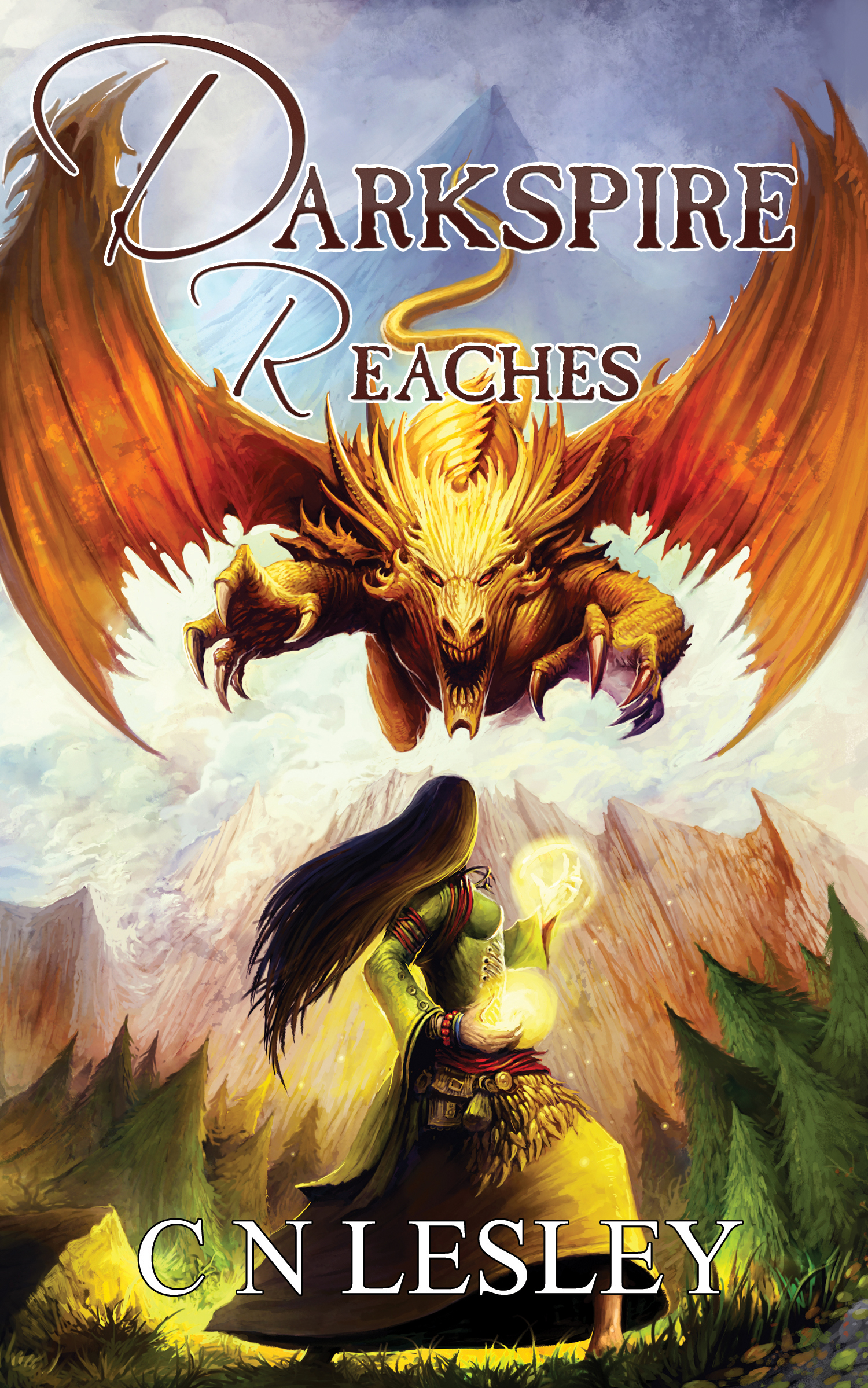
Um no, this may be a popular assumption, but it is an incorrect one. Take Darkspire Reaches, for example, which is a fantasy world, not Earth. Ah, you may say, in that book you used Earth words to describe trees and stuff. Yep, I did. Of course I did. I had gone to a great deal of trouble to construct this world, decided on its geology, weather patterns, temperature, zones, types of flora and fauna that could possibly live successfully in this place, so naturally I used the words people would recognize. If I stick a rabbit in a story I am not going to commit the stupid trope of calling it a flubble, or a werible. If it looks like a rabbit and acts like a rabbit, then it is a rabbit.
Why all the fuzz over stuff fitting into a setting? In one word, feasibility. I can’t have violets and roses flowering at the same time. A lot of people know this doesn’t happen in reality. I can’t have a xerophyte spudded in at an unlikely location. It has to be consistent and realistic to allow the reader to sink comfortably in the world.
What about history? Yes, that is enormously important. With the Shadow Series, beginning with Shadow Over Avalon, I wanted to find what the true King Arthur might have been like. This involved going back to the original Welsh legends to avoid the politically correct fabrications firmly in place by the time of Mallory. Fabrications? Oh yes. In Medieval times it was considered almost necessary to go on a pilgrimage; something the church really promoted as the end destination raked in on cha chink right royally. In those times, Glastonbury Abby ‘discovered’ the bones of King Arthur and his queen in their precincts. (One hopes they were not over-zeolous about procuring the right sort of bodies). Now the problem was that hyping up the Arthurian legends meant mentioning women of power. Oh quel horreur! Women couldn’t have power! That couldn’t happen, therefore one Geoffrey of Monmouth set out to discredit pagan priestess Morgan Le Faye and he made a bang up job of it. Now to elevate Arthur, who was most probably a pagan king. Easy enough with chivalry, knights and holy quests, excepting there were no knights in Arthur’s real time-frame. Also look closely at the objects in the major stories. A sword and a grail. Writing was a real pain way back when and I imagine it took Geoffrey’s whole life work to put all this down on vellum in beautiful script done with a quill or two, not to mention the gold leafing trim. This explains the absence of the other two power objects, the wand and the pentacle.
Look at the old Tarot sets and the names will be very different. Swords, Cups, Pentacles and Wands; not Swords, Chalices, Coins and Batons as they became to fit in the need for the right sort of chappy to go visit on a pilgrimage. Arthur was Christianize, as were many of the trappings from the pagan days. Of course the monks could get away with whatever they wanted to say to swing a pilgrimage route in their direction. At that time, they were the only ones, aside from a very few nobles, who could read. History is absolutely fascinating when taken back to the nth degree.
I will only use a small fragment of the material I researched for the Shadow Series. It doesn’t matter. What does matter is I have a real handle on Arthur and his times. And just how did ancient men raise Stonehenge? The jury is still out on that one.

